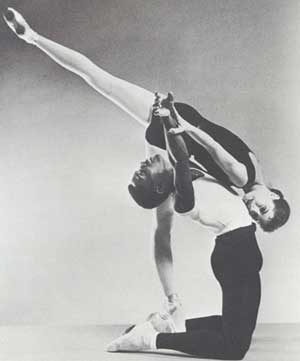
In Pursuit of Perfection

Ashley Bouder, Principal dancer of New York City Ballet, is known for her dynamic and daring performances; yes, she sometimes falls, but she’s happy to accept those as a by-product of taking risks. She said in a recent interview that ballet isn’t about achieving perfection and that the excitement of live theatre lies in the fact that things may go wrong, which is acceptable if a dancer is going all out: I’m inclined to agree with Ms. Bouder.

The training of classical ballet technique is the pursuit of perfection; always reaching for the ideal – pushing for a little more turn-out, a higher extension, that extra pirouette. We all know the reason the discipline has lasted so long is because once perfection is neared it moves that bit further away, which is why dancers and teachers return day after day to the studio in the hope that they might be the one that gets there. A simple extrapolation of this idea is that of the perfect performance.

Pristine execution is what dancers strive for. Companies like L’Opera National de Paris are known for this; and it is their most common criticism. To make something too perfect, removing its every flaw, is to eradicate its human-ness. A dancer doing 5 pirouettes, with aplomb, is a thing of distant beauty; a dancer going for 5 pirouettes, veering slightly off-balance and pulling it back to finish triumphantly, is exciting and engaging. So many times teachers tell dancers that ballet is about concealing the effort, but an audience can’t be expected to appreciate something which looks like its being tossed out with nonchalant ease.

When you are drawn to a performer, it is because you see their intention; you sense their intense commitment to the moment and you become party to their efforts. When you are involved like this, you root for the dancer – if they fall because they get carried away in the moment, you love them even more. Those dancers that are known for their charisma are never the ones that are concerned with perfection.

It is easy to become blinkered trying to get to that unreachable goal, but if you don’t give yourself wholeheartedly to the journey, it’s all in vain. So, Ms. Bouder, if you’re reading this, long may you give yourself to the moment – you may not stay upright, but you’ll still have our hearts.

Tagged , ,

James Löffler: LFO

LFO

Resolution! at Robin Howard Dance Theatre, The Place, London

7 February 2012

The blurb for LFO is full of technical jargon about waves and frequencies, and to see how this was manifested as an intense collage of human relationships was what really struck a chord – how an abstract scientific idea can fuel a beautiful physical response.

The opening video vignette, to Fat Boy Slim, was slick and gave the piece a universal and progressive edge, with a strong, if indefinite, political slant. What ensued was a succession of solos, duets and ensemble numbers, all danced to music that would be more expected in a club than a theatre – this served to highlight Löffler’s musical prowess, having edited and mixed the tracks himself as well as crafting the choreography.

There was something of an 80’s loucheness to the movement at times, especially in the solo moments with Chris Linda, whose expressive torso emulated the wave motion which inspired the work. Tempering this were sections of architectural classicism, particularly in the duet between Melanie Cox and Richard Hackett, which was beautiful in its restraint. In general the partner work was innovative and interesting, nothing looking contrived or familiar. The closing solo, danced by Sonoya Mizuno, was joyous: her impressive physicality not overshadowing the clarity and purity of the movement.

Löffler has managed to create a work that has none of the pretence and baggage which attaches itself to so many new choreographies – it is fresh and has a definite “now” feeling to it. Regardless of the motive behind the piece, although there was no discernible narrative or pretext, this was simply an impressive piece of choreography, danced with maturity and assurance: it deserves to be developed and appreciated. I’m looking forward to seeing where this talented young man takes his work next.

Tagged , , , , ,

Work/Life Balance

Numerous explanations have been postulated in the wake of Sergei Polunin’s hasty departure from The Royal Ballet. His well-documented comments in recent interviews and on Twitter suggest he is harbouring some resentment at a life dedicated to ballet, feeling like he is missing out on life having avoided hanging out on street corners. Ballet can be all-consuming, but like other professions that require years of training to get to a professional level, it’s all about achieve a work-life balance.

While being a ballet dancer is difficult – to progress it takes constant work and maintenance over the course of a career – the hours aren’t excruciating. While it is true that on performance days you might not get out of the theatre until 11pm and be expected to turn up for class in the morning, large portions of the year are spent rehearsing, which would rarely top 40 hours per week. Many other professions require a significantly higher time commitment. That said, few take such a physical toll as that of a ballet dancer and with “rest” being a necessary component of the working week if optimum performance is to be ensured and injury is to be avoided, the aforementioned work-life balance becomes tipped in favour of the latter.

Most professional dancers will have started some form of dance training at a young age and will have taken it seriously from quite early on. Dance, broadly speaking, is a discipline which is quietly competitive and can easily become the focus of a young person’s life; when this does happen, it is difficult to give equal footing to academic studies or other hobbies. Professional dancers are usually the primary source of inspiration for young dancers, and quelling the desire to emulate one’s idols is very difficult. So, from a long way out, those dancers with professional aspirations can become restricted, sometimes by their own ambition and sometimes by proxy.

It is easy to see that dance, like other creative avenues, is a vocation: it is something you will only pursue if you truly desire it and isn’t something you can just fall into. A common result of growing up with such tunnel vision is that once you get to a certain point on the journey, outside influences can present themselves, and a whole world, which was previously intangible, becomes available for enjoyment and rebellion seems like an enticing prospect.

Dancers aren’t creators, they are interpreters. Every role or piece of choreography is enriched and fleshed-out by the dancers own life experience. While it might seem like 100% dedication is required to succeed, rebellion, albeit in it’s most self-aware and controlled form,  can go a long way into making a dancer more human – this will not only translate to the stage, it will come in handy when the last curtain drops and the ballet shoes are hung up for good.

Tagged ,

A Cold, Empty Trip to Verona

Romeo & Juliet, Royal Opera House, January 19th, 2012

Kenneth MacMillan’s Romeo and Juliet has become somewhat of a calling card for The Royal Ballet; after The Sleeping Beauty it arguably the company’s most recognisable work. For Tamara Rojo and Carlos Acosta, it is a ballet that has done much in advancing their careers and establishing them as internationally respected ballet stars, both individually and as a principal couple. The evidence from this performance suggests that both the lead dancer’s performances and the company as a whole need a shake-up if this production is to avoid the ballet scrap-heap.

The sold-out house is a clear indication of the esteem in which both the ballet and the Acosta/Rojo partnership are held and while there were several glorious moments in this work, such as the dance of Juliet’s friends and a wonderful Mandolin dance, there is simply not enough to justify the following. It was in the street scenes that the cracks of disrepair are starting to show: the harlots, wearing what look like fright-wigs, have lost their gritty edge and the general hustle-and-bustle drama around the edges is gone. While both of these are probably victims of under-rehearsal, the sword fighting seems to be suffering from the opposite; the metronomic meeting of the blades has become more of an exercise in counting completely lacking spontaneity. These smaller elements are suffering, presumably with a bulk of rehearsal resources being aimed at the flashier moments, and need some love and attention if the ballet is to retain any sense of theatrical coherence.

The legendary Rojo – Acosta pairing seems always to be a draw. Not only are they celebrated for their technical proficiency, but this ballet is generally accepted as the perfect vehicle for their acting prowess and on-stage chemistry. Whether it was an off-night or they’ve done so many that they are on autopilot at this stage, none of their famed passion was on display. The role is an ideal showcase for Acosta’s preternatural turning ability, and he duly obliged on this occasion, but his acting was flat – a boyish nonchalance coming across the footlights as complacency. Rojo’s technique is much feted, but sometimes, as was the case on this occasion, it stifles her; everything was so assured and studied that it lost any sense of movement and belied her character’s emotional whimsy.

While the principal couple failed to ignite any interest, the supporting roles provided far more interesting viewing. Christopher Saunders and Genesia Rosato as Lord and Lady Capulet performed with elegant gravitas and Rosato’s grievance over Tybalt’s body was devastating. Gary Avis and José Martín as Tybalt and Mercutio respectively, were proof that multiple visits to a role don’t need to induce stagnation.

Romeo and Juliet has been a cornerstone of the Royal Ballet since it premiered in 1965. What should become richer and more nuanced with time – and MacMillan’s choreography still has the capacity to be danced gloriously – has become lazy, with many of the performances being danced from memory, rather than with the engaged presence it deserves. The ballet needs to be curated in its entirety, with the roles of every size and visibility given adequate attention: otherwise it will become a pastiche, and a dusty vestige of MacMillan’s original masterpiece.

Tagged , , , , , , ,

Of Their Time


Fonteyn and Nureyev in rehearsal for Marguerite and Armand

When something which is created for a specific event – inspired by and commemorating a special occasion – it should be enjoyed for that purpose and that purpose only, leaving after it a lingering image through which it can be remembered. Ballets created for such purposes, such as Ashton’s various pieces d’occasion, should be similarly treated, rather than being wheeled out every few seasons, their significance deteriorating with every performance.

Two particular works come to mind on the subject of pieces d’occasion: Ashton’s Birthday Offering, created for the 25th anniversary of the Royal Ballet, and Marguerite and Armand, again an Ashton work and a vehicle specifically, at the time, for Fonteyn and Nureyev. Both of these ballets were created for a particular situation – the first an important milestone, the second a legendary pairing – and longevity was never the desired quality. The fact that they are both in the repertoire of the Royal Ballet for the 2011/12 season shows that while it wasn’t what the choreographer originally intended, both works have enough choreographic integrity to ensure they have lasted.

Every choreographer has their first cast – those dancers that will dance the opening night and a majority of performances, but most ballets are choreographed to survive and have don’t have roles that “belong” to  particular dancers. These two ballets are exceptional in that sense. It wasn’t until Sylvie Guillem and Nicolas Le Riche were granted permission to dance Marguerite and Armand that anyone had dared touch those roles created by, and for, Fonteyn and Nureyev. The fact that this occurred after the death of Ashton and before the recent establishment of The Frederick Ashton Foundation surely says something on the matter. Birthday Offering did enjoy various revivals during Ashton’s lifetime, but the ballerina solos will forever be attached to their creators whose unique qualities they were designed to celebrate.

Balanchine never put together a ballet with a view to it outlasting him, but he did frequently revive previous works, changing the choreography as he saw fit for the current cast. Ashton was unlike Balanchine in that he showed more reverence for his original work, seeing the choreography in less of a state of flux than his trans-atlantic contemporary. Any revival of these pieces d’occasion can only ever be a shadow of their original as a result.

We may be half a century on  from the creation of these two ballets, and ballet training and technique may have moved to a different level – not a higher one, but somewhere else. Neither creation was intended as a technical exercise which would be extended over the years; both were about capturing a particular moment, a snapshot of a specific group of dancers, doing what they did most beautifully. Should these ballets not be performed any more, those who weren’t around first time miss out, but even when they are performed now, we are deprived of what they were intended to be: they were of their time, and there they shall remain.

Tagged , , , , , , , ,

Playing It Safe

Programming is an issue for ballet companies of all sizes; but the choice between running work that will guarantee an audience and an unfamiliar ballet is more than an economic decision – it brings into question the purpose of a company’s existence. To avoid becoming yet another irrelevant vehicle for diluted versions of the Petipa classics, companies must take the unmarked path: a little bravery can go a long way.

The basic purpose of a ballet company is to entertain; this is by no means an attempt to undermine the art of ballet – a majority of the audience are there for the escapism and have no academic interest in what is happening on stage. In a competitive field, such as that of theatre, ensuring quality is paramount – in ballet, this means engaging the services of trained professionals, and paying them commensurately.

Once money becomes involved, art loses its purity of purpose and takes on a commercial edge. Regardless of the funding status of companies – in Europe, many are lucky enough to be state subsidised, unlike in the U.S. or Japan, for instance, where private sponsorship and philanthropy is big business – box office numbers are the most important statistic; if seats aren’t being filled, the operation isn’t viable. Those audience members looking for some escapism courtesy of what is widely known as ballet – that magical land full of swans, sylphs and sugar plums – will come to see a production they’ve seen before or at least heard of: to get full theatres, companies are under pressure to mount recognisable, respected work. Respect and recognition from within and from without the ballet community mean very different things.

Repeatedly sold out performances of the classics are hard evidence of what draws in the crowds. However, ballet companies must present new work if they are to retain any artistic relevance. Commissioning a brand new ballet represents a huge financial risk – not only will sales for the period of programming suffer, but sets and costumes will remain unused. The Royal Ballet presented Twyla Tharp’s Mr. Worldly Wise in 1995 and such was its commercial failure that no new full-length narrative ballets were created again until Christopher Wheeldon’s Alice in Wonderland in 2011 – the latter, which drew rave reviews, was indeed a success at the box office, if not offering much novelty with its choreography. Generally new work comprises a third of a triple bill – almost as if the other two older works are being used as bait to lure the apprehensive audience.

Decision makers in companies have a difficult job. In order to mount work and employ dancers of high quality, they need to generate sufficient revenue. To develop new audiences, however, they need to get people talking: maybe Mr. Worldly Wise wasn’t the best ballet of ’95, but it certainly got a reaction.

Tagged , , , ,

It’s Tough At The Top

The majority of dance company directors have served their time as senior dancers, whether in the company they now head, or another. If history has taught us anything it’s us that being a good dancer has little bearing on one’s capacity as an effective director. There is no well-worn track to such a position; most directors take their own route, but the most successful ones are those that strike the right balance between being responsible, savvy, sensitive and knowledgeable.

Taking on the role of director means both taking care of  and carrying forward the vision of those that have gone before; every decision must be made with the interests of the former directors in mind, while keeping an eye on the current artistic climate and taking informed steps towards the future. This is the reason so many companies have former dancers at the helm; they grew up with the repertoire and have a thorough knowledge of it in its context: As well as knowing the ballets in the company history, for more established companies there will be a certain style that is inherent – this will always be evolving and for someone that has come of age alongside that style, there will be an innate knowledge of what direction in which to take it, keeping an eye on the training and coaching the dancers receive. Suitable casting and promotion will also be informed by this knowledge. Two examples of this type of journey to artistic direction are Peter Martins of New York City Ballet and Monica Mason of the Royal Ballet – both were dancers in their respective companies for their entire careers, and then worked their way through the ballet staff ranks, taking with them a lifetime of knowledge. Wayne Eagling, director of English National Ballet, came from outside the organisation, but his experience as a dancer in the Royal Ballet and as director of Het Nationale Ballet would have given him a broader frame of reference. Either way, a thorough understanding of the art form, and to an extent the heritage of the company, is of paramount importance if the director is to take it on an appropriate trajectory.

Dancers are sensitive creatures; although they can be tough when it comes to their work, long days looking in the mirror means a soft-touch can go a long way. A career as a dancer will, hopefully, leave one with a lasting memory of the daily anguish that tends to go hand in hand with being under constant scrutiny. Once a dancer retires, their dancing life remains imprinted on their mind and body – for a dancer that goes on to direct, this imprint will inform their every decision. They will have peoples careers in their hands, and will have to remember what it is like to be in such a precarious position. They are also in the important position of being responsible for giving generously of their knowledge, passing on what they have learned to another generation; this is most important for those directors involved in coaching roles they themselves have danced. The director is someone to whom every member of the company looks for leadership – they should never forget what it is to be a dancer, or they run the risk of being unable to communicate sympathetically with their dancers.

Aside from the human and artistic understanding that is demanded for such a position to be effective, the role of director is also one of management. Knowledge of the organisation is required; in bigger companies there is a specific hierarchy, among both dancers and administration. While some of the more prominent organisations will have dedicated staff for the purpose, the areas of funding, philanthropy, outreach, development and marketing need to be  considerations in taking a company forward in the competitive world of the arts. With dance companies being such public entities, the director is the one that will take the backlash of any failures: the position requires someone decisive, resolute and at ease with the fact that every decision made will have its detractors.

It’s hard to imagine a recruitment advertisement reading: “Wanted: Artistic Director. Must have in depth knowledge of company heritage, repertoire, coaching and arts administration. Parental warmth and clinical decisiveness needed on an ad hoc basis”, but this might just sum up what is needed.

Tagged , , , , , , ,

Ballet in 2012

Unquestionably, the main event on the sporting and cultural horizon in 2012 is the Olympic Games. Dancers, wide-ranging in abilities, are reported to number over 10,000 for the opening and closing ceremonies. There’s plenty of dancing going on outside the Olympic stadium too, unfortunately to much smaller audiences.

As part of an initiative called Dance GB, three companies – English National Ballet, Scottish Ballet and National Dance Company Wales – are each presenting specially commissioned works on the Olympic theme to commemorate the occasion: it will be interesting to see what the three companies come up with. Birmingham Royal Ballet will use the same team that created the very impressive E = mc2 to give us Higher, Faster, Stronger, a ballet taking inspiration from the Olympic ideals.

Not on the same competitive theme, but none the less challenging, The Royal Ballet has teamed up with The National Gallery to create Metamorphosis: TITIAN 2012. This work will take three of Titian’s masterpieces – Diana and Actaeon, The Death of Actaeon and Diana and Callisto – as the starting points for three ballets. Each ballet will have a choreographic team: Christopher Wheeldon and Alastair Marriott; Wayne McGregor and Kim Brandstrup; Will Tuckett, Liam Scarlett and Jonathan Watkins. With such a huge wealth of talent and experience, this could be the highlight of the year. On the other hand, with so many different voices it could end up being a confused mess.

While all that is going on over at Covent Garden, Sadlers Wells is buzzing at the prospect of Ivan Putrov’s Men in Motion. We’ve all seen this type of show before – a group of dancers brought together under a certain theme (here that seems to be that they are all male), to dance some fairly unrelated choreography – and we know that they can be somewhat shallow affairs. This one I have a good feeling about. Putrov will be performing Ashton’s Dance of the Blessed Spirits, taught to him by Anthony Dowell who last danced it over 30 years ago; Daniel Proietto will wow audiences in Russell Maliphant’s Afterlight, just like he did 2 years ago on the same stage; Putrov will be joined by the Maryinsky’s Igor Kolb and Royal Ballet’s Sergei Polunin in Nacho Duato’s Remanso, which is a beautiful celebration of the man in motion.

On the topic of men in motion, one man that will be making his movements felt this year is choreographer George Williamson. A graduate of English National Ballet School, Williamson has said that he wants to make “fresh work in the classical language”. His language is right on the pulse – it is wildly athletic. This year will see him create on New English Ballet Theatre and re-imagining The Firebird for English National Ballet’s Beyond Ballet Russes programme. With such illustrious credits to his name so early on in his career it will be interesting to see where Williamson goes in the next few years.

Aside from choreographic debuts, and Dance GB, there’s more afoot at English National Ballet in the guise of My First Sleeping Beauty. Like Angelina Ballerina, this is billed as a children’s ballet and is part of the company’s drive to generate family audiences. Matthew Hart is the choreographer here and I am a fan of his work – he is passionate about narrative ballet and telling a story through steps. Another new Beauty that will be touring UK and Ireland is that of Ballet Theatre UK. This will be artistic director Chris Moore’s fourth full-length ballet for the troupe and the quality of work belies the size of the company.

Tagged , , , , , , , , , , , , ,

Darcey Does Hollywood

Darcey Bussell Dances Hollywood, BBC 1, Christmas Day

On Christmas day we saw Darcey complete her latest challenge: recreating four iconic dances from the musicals of Hollywood’s Golden Era. This went a long way to promote the genre of theatre dance, but little to champion the cause of ballet.

Many people both here and previously, even Baryshnikov, have awarded to Fred Astaire’s the hypothetical accolade of greatest dancer that has ever lived. The worthiness of Astaire as title holder is difficult to assess given the breadth and depth of dance across the years, but to be acclaimed by those who themselves would surely have been featured in any debate on the topic is a strong indicator of peer-respect if nothing else. Astaire was gifted with a sense of style and theatricality that became a landmark of his era. Others possessed this to varying extents: Ginger Rogers, Vera-Ellen and Gene Kelly, for example. What made their talents truly magical was the way they made choreography that was technically and stylistically difficult look like a spontaneous expression of joy.

There was a full and candid film diary of the process Darcey went through to get from learning the choreography to performing the routines with the requisite gay abandon. The studio footage we were shown wasn’t that of a prima ballerina whipping through the steps with ease; Bussell, not exactly decrepit, but not quite at her physical peak either (at her own admittance), struggled with the work. It was open and honest. Even for someone as physically adept as Darcey, the transition between genres is tough and not as easy as programmes such as Strictly Come Dancing would lead us to believe; this was both refreshing and frustrating.

There is a fundamental difference between this programme and Strictly: here we get to see a world class ballerina at pains to attain a level as close to perfection as she can; in Strictly we see celebrities transformed into “dancers” in a couple of weeks, with a few hours rehearsal per day. One of these scenarios is a nod to the work that must go into achieving some kind of technical or artistic mastery; the other trivialises the discipline, suggesting that with a few weeks of training, anyone can do it. Reality TV has let people believe that they can be anything they want in an instant; the contestants on such dance shows always pay homage to the dancers after they get a glimpse of what the training involves – but it is just that: a glimpse. Dance is a lot more than a jazzy outfit and a stage-smile, especially when the level sought is so high, and thankfully Darcey showed us just that.

However, just like the dance of Astaire’s era, ballet is demanding in technique and artistry – probably more so than any other dance style. At the beginning of the show, we saw Bussell in an excerpt from Ashton’s Sylvia, at the height of her powers; just to hammer home how good she was within her own genre – the culmination of a lifetime of toil, God-given natural facility and the indescribable quality that made her so watchable. The journey she made here is rarely made in the opposite direction, however; we never see a celebrity, let alone a dancer from a different field, tackle the world of classical ballet: it is not a path than dared be tread in a few weeks.

What we saw here was a dancer not afraid to expose herself to criticism or hardship in her search for perfection; we saw all the seams before we got to see any of the very impressive finished product. Without doubt someone could find fault in her work, but definitely not in her work ethic. Looking between the lines here we wouldn’t be blamed for seeing the ballet dancer placed on top of the dance food-chain, able to turn to other styles with their fearless work-ethic, but I think Bussell is quite apart from the masses here. Ballet should be championed through something like this, for the work it takes to be at the top if nothing else, but once again the spangles win out. If only someone would give the return journey a serious go, maybe ballet would be acknowledged for what it is – a life’s work.

Tagged , , , , , ,

Retrospection

Forgive me while I don’t compile a list of the year’s successes and failures. Once again the time is upon us for the critics to look back on what has happened over the last twelve months, and give claps on the back to those who triumphed and look witheringly upon those who floundered. With most of what happens on stage being somewhere in between these two extremes and eliciting nothing more than indifference, these yearly reports might be the stand out memories of one but are far from representative of the year’s activity. Surely a 500 word (if you’re lucky) snippet detailing the good and the bad is of very little constructive use. I could tell you that I adored English National Ballet’s Suite en Blanc (which I did), but that’s just like sharing the fact that I love blue cheese – it’s immaterial.

Many people look on critics with scorn, thinking “why should we be subjected to the opinion of one person?” Critics realise that they are just one person, and one opinion. What is expected of them is that they know their subject well enough to be able to assess whether it is worthy of people’s time and effort. Ismene Brown recently said that critics are essentially sales people; their job is to get people into the theatre, deftly adjusting their expectations along the way.

In this way, it is nice for a critic to be able to refresh people’s memories of what their highlights and dark spots were in a year of performances. Such an article is limited in its usefulness, what with the events being in the past. In its stead, perhaps a more detailed report would be appropriate; one showing trends – what worked, what didn’t. The critics aren’t by any means influential in decision making when it comes to casting, programming or funding; but they are a voice with numerous listeners.

Whether critics are agreed with is entirely out of their hands. Anyone who does read their thoughts, whether they concur with what is on the page/screen in front of them, must care what their sentiments are – on some level. Perceived as being a public voice of specific knowledge, the critic should give information that can be used to advance; there’s no good in being told how wonderful, or awful, you or your production was, unless you’re also given an insight into why – only then can we move forward and keep dance relevant.

Tagged , , ,
Follow

Get every new post delivered to your Inbox.